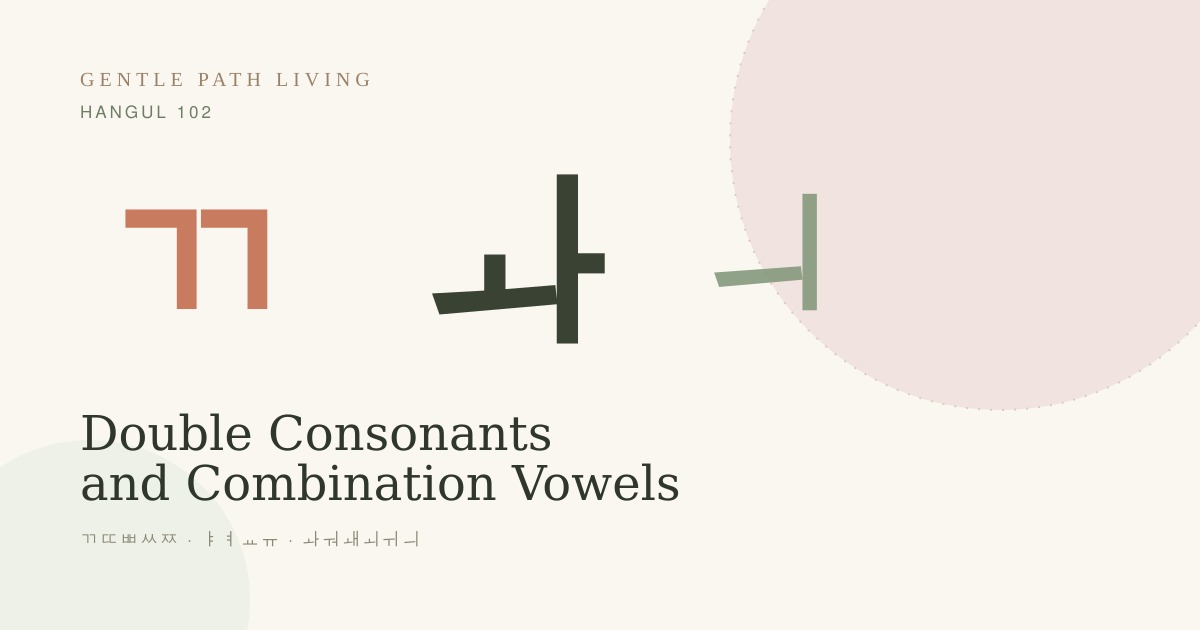
안녕하세요? 오늘은 쌍자음과 쌍모음에 대한 수업이에요. 쌍이라는 말은 couple이란 의미로 많이 쓰여서 두 개가 겹쳐진다는 의미에요. 영어로 double이라고 하는 게 좋겠죠.
In the last post, we covered the 10 basic consonants and 8 basic vowels — enough to start sounding out simple words like 한국 and 사랑. Today we’re finishing the alphabet: the “tense” double consonants, and the vowels that combine two sounds into one.
These are the letters most beginners (and even some heritage speakers who never formally studied Hangul) find trickiest — not because they’re complicated to write, but because some of these sounds simply don’t exist in English.
The Five Double Consonants (쌍자음)
These are written by doubling a basic consonant, and they represent a “tense” or “fortis” sound — produced with more tension in the throat and no puff of air, almost like you’re holding the sound back slightly.
| Hangul | Based on | Rough sound |
|---|---|---|
| ㄲ | ㄱ | tense “kk,” like the k in “sky” (not “key”) |
| ㄸ | ㄷ | tense “tt,” like the t in “stop” |
| ㅃ | ㅂ | tense “pp,” like the p in “spin” |
| ㅆ | ㅅ | tense “ss,” sharper and more clipped than ㅅ |
| ㅉ | ㅈ | tense “jj,” sharper than ㅈ |
A useful English trick: the basic consonants (ㄱㄷㅂㅅㅈ) are closer to English k/t/p/s/j said at the start of a word with a small breath of air. The doubled versions are closer to those same sounds said in the middle of a word, where English speakers naturally drop the puff of air — think “sky” vs. “key,” or “stop” vs. “top.”
This pair shows up constantly and changes meaning entirely:
- 불 (bul) = fire | 뿔 (ppul) = horn
- 달 (dal) = moon | 딸 (ttal) = daughter
- 살 (sal) = flesh/age | 쌀 (ssal) = rice
The Y-Vowels (이중모음, part 1)
These are formed by adding a small extra line to a basic vowel, which adds a “y” sound before it.
| Hangul | Based on | Rough sound |
|---|---|---|
| ㅑ | ㅏ | yah |
| ㅕ | ㅓ | yuh |
| ㅛ | ㅗ | yoh |
| ㅠ | ㅜ | yoo |
Heritage learners: you’ve definitely heard these — 교회 (gyo-hoe, church), 셔츠 (syeo-cheu, shirt), 휴지 (hyu-ji, tissue). Once you connect the small extra stroke to the “y” sound, these become very easy to spot.
The Combination Vowels (이중모음, part 2)
These blend two vowel sounds together into a single glide. They look more complex but are very regular once you know the two vowels being combined.
| Hangul | Made from | Rough sound |
|---|---|---|
| ㅘ | ㅗ + ㅏ | wah |
| ㅝ | ㅜ + ㅓ | wuh |
| ㅙ | ㅗ + ㅐ | weh |
| ㅞ | ㅜ + ㅔ | weh (nearly identical to ㅙ) |
| ㅚ | ㅗ + ㅣ | weh (in modern speech, merges with the two above) |
| ㅟ | ㅜ + ㅣ | wee |
| ㅢ | ㅡ + ㅣ | special case — see below |
That last one, ㅢ, is worth a special note: its pronunciation actually shifts depending on where it appears in a word. At the start of a word it’s pronounced closer to “eui.” In the middle or end of a word, or when used as the possessive particle 의 (“of”), it’s commonly pronounced like “eh” or even just “eh” — 나의 (na-ui, “my”) is often heard as “na-eh” in casual speech. Don’t worry about mastering this one immediately; it’s one Korean speakers themselves treat flexibly.
For Heritage Learners
If a word in this post made you go “oh, that’s how you write that” — that’s exactly the goal. You’re not learning new sounds, you’re learning the spelling for sounds you already make correctly. Try writing out five family or food words from memory using today’s letters before checking them: 할아버지, 쌍둥이, 교실, 뭐, 의자 are good ones to try.
For Complete Beginners
Don’t stress about perfecting ㅙ vs ㅚ vs ㅞ right away — even native speakers often pronounce these three identically in casual speech. Focus first on clearly distinguishing the double consonants (ㄲㄸㅃㅆㅉ) from their basic counterparts, since that distinction actually changes word meaning.
Practice Words
- 꽃 (flower) — try the tense ㄲ
- 워터 (water, as a loanword) — practice ㅝ
- 의사 (doctor) — practice ㅢ at the start of a word
With this post, you now have the full Hangul alphabet. Next time, we’ll cover batchim (받침) — the final consonants at the bottom of a syllable block — which is where Korean’s famous “blue/blow” rule and several pronunciation shortcuts come into play.