
지난 시간에 이어 을과 를에 대해 더 배워보기로 해요.
You now have a real toolkit: you can read any Hangul syllable, you know both number systems, and you can mark a topic or subject with 은/는 and 이/가. Today we add the last major piece for a basic sentence — the object particle 을/를 — and put everything together.
The Form Rule (Same Pattern as Before)
By now this pattern should feel familiar — it’s the same consonant/vowel logic as 은/는 and 이/가.
| Noun ends in | Object particle |
|---|---|
| Consonant (batchim) | 을 |
| Vowel (no batchim) | 를 |
밥 (rice/meal, ends in ㅂ) → 밥을. 커피 (coffee, ends in 이) → 커피를.
What It Marks
을/를 marks the object of the sentence — the thing the action is being done to. In English, word order tells you this (the object usually comes right after the verb). In Korean, the particle tells you, which is part of why word order in Korean can move around more freely than in English.
Korean Word Order: Subject-Object-Verb
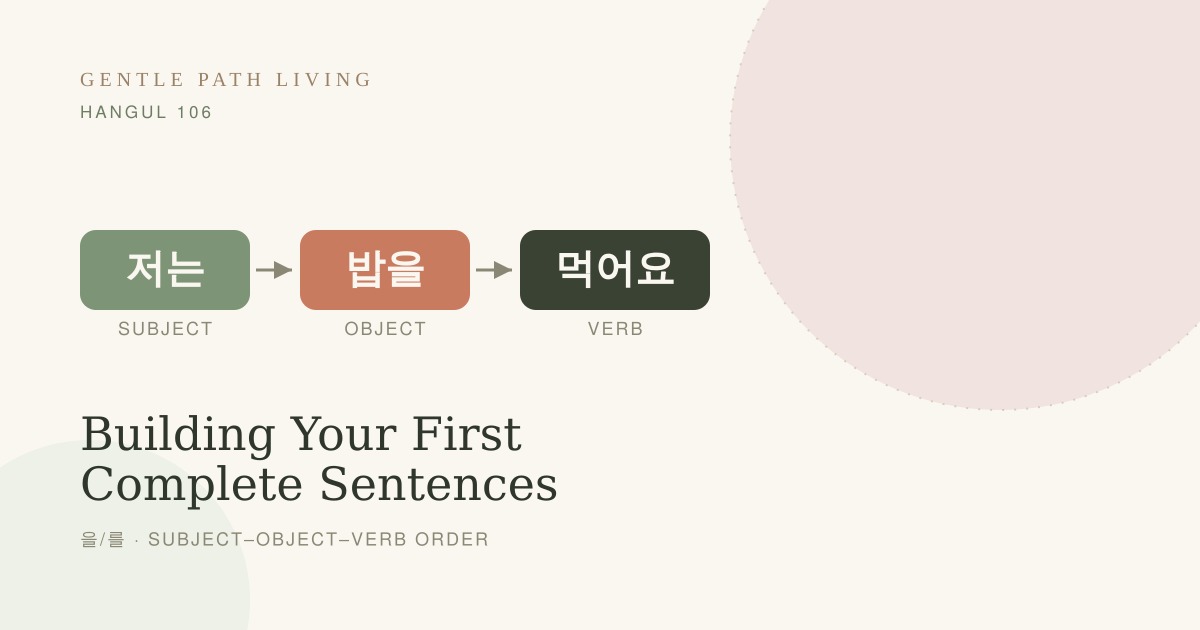
This is one of the biggest structural differences from English. English is Subject-Verb-Object (“I eat rice”). Korean is Subject-Object-Verb (“I rice eat”):
저는 밥을 먹어요.
(I) — (rice) — (eat)
The verb always comes last. This holds true no matter how long or complex the sentence gets — everything else can shuffle around, but the verb anchors the end.
Putting the Whole Series to Work
Here’s a sentence using almost everything covered so far — topic, object, and a number:
저는 친구 두 명을 만나요.
(As for me) — (friend, two people) — (meet)
“I’m meeting two friends.”
Notice 두 명 uses the Native Korean Words number (둘 → 두 before a counter) since it’s counting people — exactly the rule from the numbers post.
A Note on Dropping Particles in Casual Speech
In fast, casual conversation, Korean speakers very often drop 을/를 (and sometimes 은/는, 이/가) entirely when the meaning is already clear from context. “밥 먹어요” without 을 is completely normal and extremely common. Don’t be surprised if you hear this constantly — it doesn’t mean the particle is optional to learn, just that fluent speech often compresses it away.
For Heritage Learners
If you’ve ever dropped 을/를 naturally in casual speech without thinking about it, that’s actually a sign of correct native-level instinct, not a gap in your Korean. The exercise worth doing here is the opposite direction: take a sentence you’d normally say casually and add the particles back in, to build the conscious awareness that supports reading and formal writing.
For Complete Beginners
Always include 을/를 explicitly while you’re learning — it’s the safety net that keeps your sentences clear and grammatically correct, even if native speakers drop it around you. You can start dropping particles naturally later, once the underlying structure is automatic.
Practice
- Add the correct particle: 책___ 읽어요. (reading a book)
- Put in SOV order: I / coffee / drink → ___
- Try building your own sentence: [topic]은/는 [object]을/를 [verb].
Next time, we’ll tackle verbs themselves — specifically the -아요/-어요 present tense ending, which is the single most useful pattern for sounding natural in everyday conversation.