
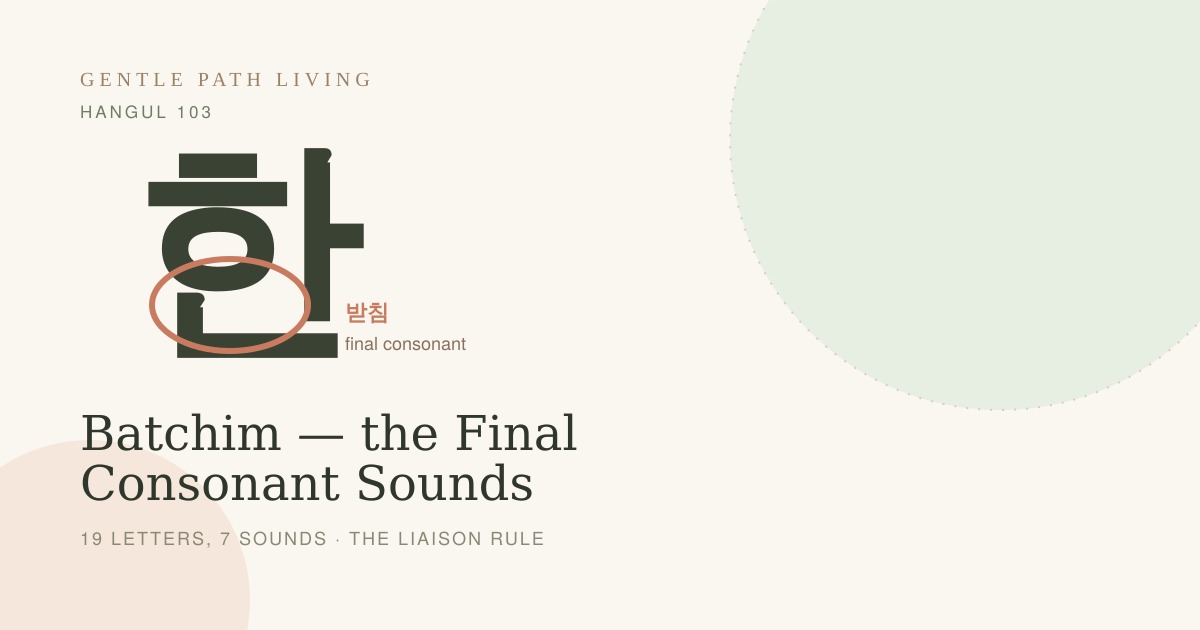
오늘은 받침에 대해 공부할 거예요. 받침은 영어에는 없는 거라 무척 생소하게 느껴지겠지만 읽고 나면 쉽게 이해가 될 수 있어요. 예를 들어 오 (five)에다 ㅅ을 넣으면 옷이 되는 거죠. 궁금하지 않아요? 어떤 소리로 들릴지 오디오도 준비 중이에요.
You now know all the basic letters. This post covers something different: not a new letter, but a rule — what happens to consonants when they sit at the bottom of a syllable block, in the position called 받침 (batchim).
This is the part of Korean pronunciation that trips up even advanced learners, because the spelling and the sound often don’t match. The good news: the sound side of it follows a very small, very predictable set of rules.
The Big Idea: 19 Letters, 7 Sounds
Korean has 19 consonants that can technically appear as a batchim. But no matter which one is written, it only ever gets pronounced as one of 7 representative sounds. Once you learn these 7, you can pronounce any batchim correctly.
| Sound | Written as (any of these) | Example |
|---|---|---|
| -g (ㄱ) | ㄱ, ㅋ, ㄲ | 책 (chaek, book) |
| -n (ㄴ) | ㄴ | 눈 (nun, eye/snow) |
| -d (ㄷ) | ㄷ, ㅌ, ㅅ, ㅆ, ㅈ, ㅊ, ㅎ | 옷 (ot, clothes) |
| -l (ㄹ) | ㄹ | 물 (mul, water) |
| -m (ㅁ) | ㅁ | 밤 (bam, night/chestnut) |
| -b (ㅂ) | ㅂ, ㅍ | 밥 (bap, rice/meal) |
| -ng (ㅇ) | ㅇ | 강 (gang, river) |
Notice that whole row of letters collapsing into “-d”: ㄷ, ㅌ, ㅅ, ㅆ, ㅈ, ㅊ, and even ㅎ all sound identical as a batchim — a clipped, unreleased “-d/-t” sound, like the end of the English word “bat” said without opening your mouth again. This is exactly why 옷 (clothes) and 못 (cannot/nail) and 낫 (sickle) all end in the same sound despite being spelled with different final letters.
The Liaison Rule (연음)
Here’s the rule that explains a huge amount of “wait, that’s not how it’s spelled” confusion: when a syllable ending in a batchim is followed by a syllable that starts with ㅇ (which is silent at the start, remember), the batchim sound moves over and becomes the starting sound of the next syllable.
Example: 한국어 (Korean language) is spelled 한 + 국 + 어, but it’s pronounced “han-gu-geo,” not “han-guk-eo.” The ㄱ batchim from 국 slides over to attach to 어.
This is why Korean spoken at natural speed sounds so much more connected than the spelling suggests — and it’s also why heritage learners often already say these words correctly without ever being taught the rule. You were pronouncing it right by ear long before anyone explained why.
Double Batchim (겹받침)
A small number of syllables have two consonants stacked in the batchim position, like 닭 (dak, chicken) or 없다 (eopda, to not exist). In most cases, only one of the two consonants is actually pronounced — usually the left one, though there are some common exceptions worth memorizing individually as you encounter them rather than as a rule to apply broadly. We’ll cover the most frequent ones in a future post once you’ve got the single-batchim sounds fully comfortable.
For Heritage Learners
This post is probably less about new information and more about finally seeing the “why” behind sounds you’ve made correctly your whole life. Try this: take five words you say fluently — 밥, 강, 옷, 물, 사랑 — and check which of the 7 batchim sounds each one ends in. You’ll likely get all five right on instinct alone.
For Complete Beginners
Don’t try to memorize which spelling-letters map to which sound yet. Instead, practice listening for the 7 sounds themselves in context — they’re far more useful for understanding speech than knowing the spelling rule in the abstract. The spelling will start to make sense once the sounds are familiar.
Practice Words
- 꽃 (kkot) — what sound does the batchim make here, given the table above?
- 한국인 (han-gu-gin) — try applying the liaison rule out loud
- 집 (jip, house) — straightforward -b sound
With letters, double consonants, combination vowels, and now batchim covered, you have everything you need to read basically any Korean word out loud — even ones you’ve never seen before. Next time, we’ll put it into practice with the most useful set of words for that: numbers, since Korean (somewhat notoriously) uses two completely different counting systems depending on context.