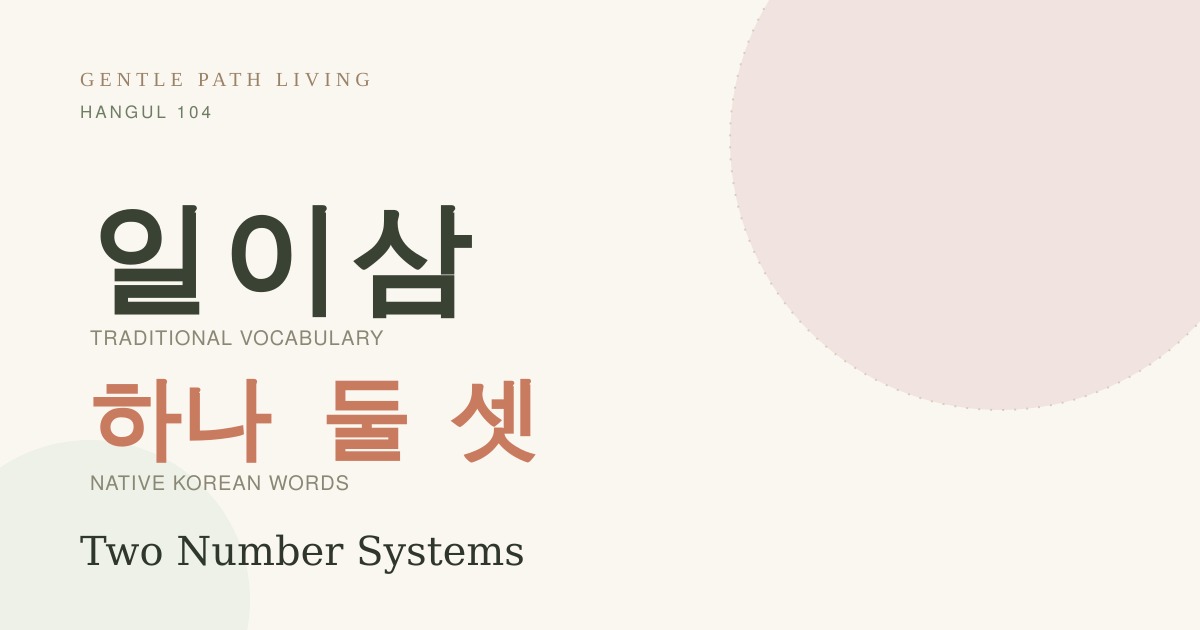
오늘은 한글 숫자에 대해 배울 거예요. 한글 고유의 수를 세는 방법과 전통적인 표현으로 (한자 표기 가능한) 두 가지 방법이 있어요. 보통 대화 속에서는 고유한 한글 표현이 많이 쓰이죠. 사과 하나 먹을래? 친구들 다섯 명과 만나기로 했어와 같은 이런 표현들이에요. 드라마를 보거나 이야기할 때 많이 쓰이고, 학교 수학 공부 시간에는 주로 전통적인 표현이 많이 사용되고 있어요.
Here’s one of the most-asked questions from new learners and one of the most quietly confusing things for heritage learners: Korean doesn’t have one number system, it has two — and they’re used in different situations, not interchangeably.
The good news is that the rule for which one to use is fairly predictable once you see it laid out. Let’s go through both.
Traditional Korean Vocabulary Numbers (한자어 숫자)
These come from Chinese characters and are used for things like phone numbers, money, dates, addresses, minutes, and math. They’re also the system used for counting in the tens, hundreds, thousands, and large numbers in general.
| Number | Hangul | Romanization |
|---|---|---|
| 1 | 일 | il |
| 2 | 이 | i |
| 3 | 삼 | sam |
| 4 | 사 | sa |
| 5 | 오 | o |
| 6 | 육 | yuk |
| 7 | 칠 | chil |
| 8 | 팔 | pal |
| 9 | 구 | gu |
| 10 | 십 | ship |
The structure beyond 10 is wonderfully logical, far more so than English: 11 is just “ten-one” (십일), 20 is “two-ten” (이십), 23 is “two-ten-three” (이십삼). There’s no separate word to memorize for “twenty” or “thirty” the way English has — it’s pure math once you know 1–10.
Used for: phone numbers, prices, dates (월/일 — month/day), minutes, floor numbers, math, and counting most things above about 99.
Native Korean Words Numbers (고유어 숫자)
This system is original to the Korean language, not borrowed, and it’s used for counting objects, hours (on a clock), and age — alongside a “counter” word that changes depending on what you’re counting.
| Number | Hangul | Romanization |
|---|---|---|
| 1 | 하나 | hana |
| 2 | 둘 | dul |
| 3 | 셋 | set |
| 4 | 넷 | net |
| 5 | 다섯 | daseot |
| 6 | 여섯 | yeoseot |
| 7 | 일곱 | ilgop |
| 8 | 여덟 | yeodeol |
| 9 | 아홉 | ahop |
| 10 | 열 | yeol |
Native Korean words for numbers only go up to 99 (스물아홉 for 29, 아흔아홉 for 99) — past that, Korean switches to Traditional Korean Vocabulary even when counting objects. So you’ll never need Native Korean words for numbers in the hundreds.
Used for: counting objects with a counter word (개, 명, 마리, etc.), telling your age, and hours on a clock — but notably not minutes, which use Traditional Korean Vocabulary. A time like “3:25” mixes both systems: 세 시 이십오 분 (se si — Native Korean Words “3” — i-sip-o bun — Traditional Korean Vocabulary “25 minutes”).
A Quick Rule of Thumb
- Counting how many of something (people, items, age) → usually Native Korean Words
- Reading a number as a number (phone, price, date, math) → Traditional Korean Vocabulary
- Telling time → hour is a Native Korean Word, minute is a Traditional Korean Vocabulary
For Heritage Learners
You likely already have Native Korean Words numbers 1–10 memorized cold from being asked your age as a kid (몇 살이에요?), but may never have connected them to a 1-10 chart, or realized there’s a second, completely separate system for phone numbers and prices. If you’ve ever felt unsure reading a price tag or phone number out loud in Korean, that’s almost always because you were trying to use Native Korean Words by instinct when the situation called for Traditional Korean Vocabulary.
For Complete Beginners
Start by drilling Traditional Korean Vocabulary numbers 1–10 until it’s automatic — it unlocks dates, prices, and phone numbers, which you’ll use constantly. Native Korean Words numbers 1–10 can come right after, focused specifically around the phrase for asking and giving age, since that’s the most common real-world use you’ll hit early on.
Practice
- Say your phone number’s first three digits using Traditional Korean Vocabulary.
- Say your age using Native Korean Words + 살.
- What system would you use to read “3,000 원” out loud?
Next time, we’ll move from numbers into the words that hold a sentence together: basic particles like 은/는 and 이/가 — small syllables that do a lot of grammatical work and trip up almost every learner at first.