한글을 처음 배우는 유치원 때부터 제일 어려웠던 부분이 바로 오늘의 주제에요. ‘아버지 가방에 들어가신다’라는 걸 농담처럼 우스개소리로 많이 들었어요. ‘아버지가 방에’를 잘못쓰면 그렇게 들리는 거죠. ‘사과는 좋아해요’ 가 아니라 ‘사과를 좋아해요’ 라고 말해야 되는 것이 처음에는 많이 혼동스러울 거에요. 차근 차근 배워보기로 해요. 이건 많이 들으며 들을 때마다 외워두어 익숙해지는 방법이 제일 좋아요.
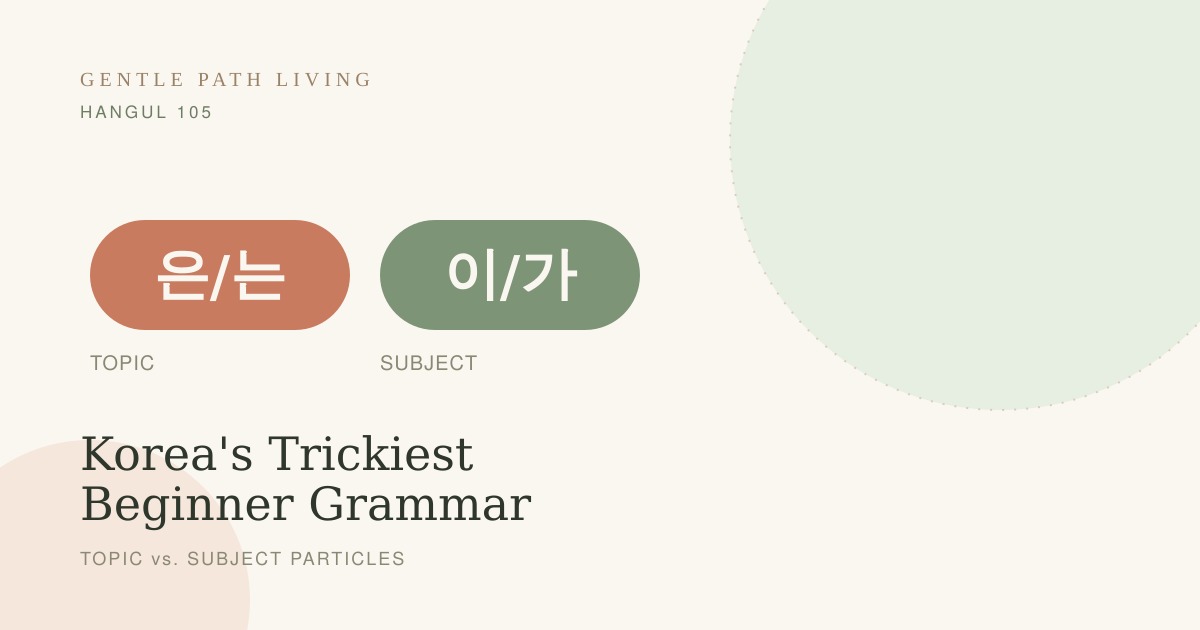
If you’ve started piecing together Korean sentences, you’ve probably already run into these four little syllables attached to the end of nouns: 은, 는, 이, 가. They’re called particles, and they’re one of the first things that make Korean feel genuinely different from English — because English doesn’t really have an equivalent.
The good news: which form you use (은 vs 는, or 이 vs 가) is a simple, mechanical rule. The harder part — and the part most learners spend years refining — is knowing which pair to use in the first place. Today we’ll cover both.
Step One: Picking the Right Form
This part is pure mechanics, based only on whether the noun before it ends in a consonant (has a batchim) or a vowel (no batchim).
| Noun ends in | Topic particle | Subject particle |
|---|---|---|
| Consonant (batchim) | 은 | 이 |
| Vowel (no batchim) | 는 | 가 |
Examples: 사람 (person, ends in ㅁ) takes 은/이 → 사람은, 사람이. 친구 (friend, ends in 우) takes 는/가 → 친구는, 친구가. That part is entirely predictable — no exceptions to memorize.
Step Two: Topic (은/는) vs. Subject (이/가) — The Real Challenge
This is the question that doesn’t have a clean English equivalent, so let’s build intuition with examples rather than a strict definition.
이/가 marks new or specific information — it often answers the question “what/who is doing this?” or introduces something for the first time.
은/는 marks the topic of the sentence — what you’re talking about — and is often used for contrast, or for things already known to both speakers.
Compare:
- 고양이가 자요. (A/the cat is sleeping.) — simply stating a fact about what’s happening
- 고양이는 자요. (As for the cat, [it/she] is sleeping.) — implies “…unlike the dog” or continues talking about a cat already mentioned
Another classic example, the one most textbooks use: imagine answering “who broke the cup?”
- 제가 깼어요. (I broke it.) — 이/가 highlights that “I” is the answer to the question, the new information being supplied
And now imagine introducing yourself for the first time:
- 저는 학생이에요. (As for me, I’m a student.) — 은/는 sets “me” as the topic the rest of the sentence is about
A Useful Shortcut
If you can mentally substitute “as for ___” or “speaking of ___” in front of the noun and the sentence still makes sense in English, 은/는 is usually right. If the sentence is really answering “who/what specifically,” 이/가 usually fits better.
For Heritage Learners
This is one of the rare cases where heritage learners don’t always have a built-in advantage — even fluent speakers sometimes can’t explain why one sounds right over the other; it’s just instinct from exposure. If 사람이 vs 사람은 both “sound okay” to your ear in different sentences but you can’t say why, that’s completely normal. The contrast use of 은/는 (singling something out against an implied alternative) is often the easiest pattern to notice first — listen for it in conversations with family.
For Complete Beginners
Don’t aim for a complete theoretical understanding yet — this distinction is something that clicks gradually through exposure, not memorization. For now, a safe starting rule: use 은/는 when introducing yourself or stating general topics (“저는,” “이것은”), and 이/가 when something is the specific answer to an implied question.
Practice
- 저___ 미국에서 왔어요. (Introducing where you’re from — topic or subject?)
- 누가 왔어요? 동생___ 왔어요. (Answering “who came?”)
- 오늘 날씨___ 좋아요. (제주도는 날씨가 안 좋은데, 서울은…) — describing today’s weather, possibly in contrast to elsewhere
Next time, we’ll add the object particle 을/를 to the mix — the marker for “what is being acted on” — and put together your first complete, grammatically correct Korean sentences using everything from this series so far.