
가장 많이 사용하는 말중에 하나가 바로 무엇, 무엇했어요, 좋아요 할 때 ‘아요’, ‘어요’ 입니다. 쉬운 것 같아도 처음에 ‘갑니다, 먹습니다’라는 ‘니다’의 문어체로 배우다가 막상 대화체로 이야기할 때 혼동하기가 쉬워요. 한 번 자세히 살펴볼까요?
You can build a full sentence skeleton now: topic, object, subject-object-verb order. The last piece missing is the verb itself — Korean verbs change form depending on politeness level and tense, and today we’ll learn the single most useful ending for everyday conversation: -아요/-어요.
Starting Point: The Dictionary Form
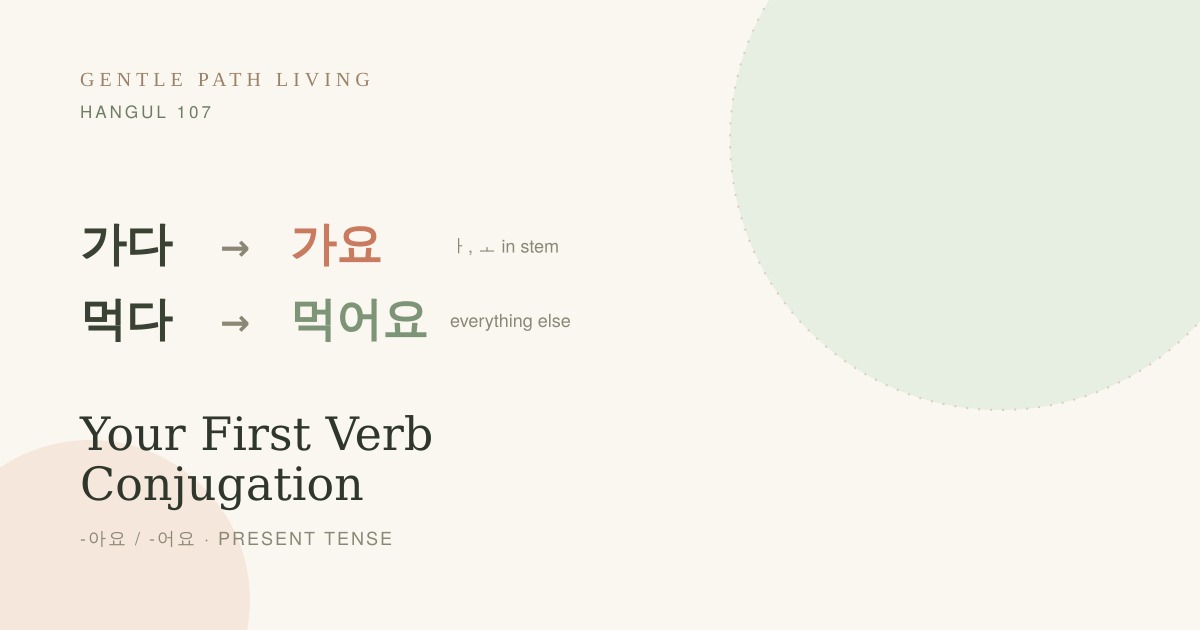
Every Korean verb has a base form ending in 다 — this is how you’ll find it in a dictionary, but it’s not how it’s actually spoken in conversation. 가다 (to go), 먹다 (to eat), 하다 (to do) are all dictionary forms. To conjugate, the first step is always the same: drop 다 to get the stem. 가다 → 가. 먹다 → 먹.
The Rule: It Depends on the Stem’s Last Vowel
This is the part that feels arbitrary at first but is actually a consistent pattern called vowel harmony.
| Stem’s last vowel | Add | Example |
|---|---|---|
| ㅏ or ㅗ | -아요 | 가다 → 가 + 아요 → 가요 |
| Anything else | -어요 | 먹다 → 먹 + 어요 → 먹어요 |
The logic: “bright” vowels (ㅏ, ㅗ) pair with -아요, and everything else defaults to -어요. You don’t need to memorize a long list of exceptions — just check the last vowel in the stem.
The One Big Exception: 하다 Verbs
Verbs ending in 하다 (a huge category — 공부하다 to study, 운동하다 to exercise, 사랑하다 to love) don’t follow the rule above. They simply become 해요.
공부하다 → 공부해요. 운동하다 → 운동해요. This single shortcut covers an enormous number of common verbs, so it’s worth memorizing as its own rule rather than trying to force it into the vowel harmony pattern.
Contractions: When the Stem Ends in a Vowel
When the verb stem itself already ends in a vowel, the added -아요/-어요 often contracts into a single syllable rather than staying separate:
- 오다 (to come) → 오 + 아요 → 와요 (not “오아요”)
- 배우다 (to learn) → 배우 + 어요 → 배워요
- 마시다 (to drink) → 마시 + 어요 → 마셔요
These contractions follow predictable patterns, too, but they’re worth learning individually as you encounter common verbs, rather than as a rule to derive from scratch each time.
Putting It Together
저는 친구를 만나요.
I’m meeting a friend.
저는 한국어를 공부해요.
I’m studying Korean.
For Heritage Learners
If you grew up speaking 해요체 (this politeness level) at home with parents or grandparents, you already produce these forms correctly by ear — 가요, 먹어요, 해요 probably feel completely natural already. What’s new here is the underlying logic, which is useful once you start encountering unfamiliar verbs you haven’t heard spoken aloud before and need to conjugate yourself.
For Complete Beginners
-아요/-어요 (often called 해요체) is the polite-but-casual level used in the vast majority of everyday situations — with coworkers, store clerks, acquaintances, and most adults you don’t know well. It’s a safe default. The more formal -ㅂ니다 ending exists too, but it’s worth setting aside until this one is solid, since 해요체 will serve you in far more situations day to day.
Practice
- Conjugate 읽다 (to read) into -어요 form.
- Conjugate 좋아하다 (to like) — remember the 하다 rule.
- What’s the contracted form of 보다 (to see) + 아요?
Next time, we’ll take this same ending into the past tense with -았어요/-었어요 — so you can finally talk about what you did yesterday, not just what you’re doing now.